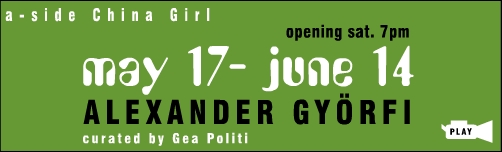

a - side China Girl |
 |
|
|
|
|
|
When I stepped into the entrance I could hear a Chinese song from my position, which was three floors down from the main room with the music. I thought 'Maybe this is an interval'.
When I arrived in the room I realised it wasn't Chinese, but German and that the music was far from being an intro or an interval between two other songs, it was twist from the 60s.
It's incredible how differently we can perceive things from what they are in the reality. Most important from this experience is the fact that a language has become like any other language. When we talk we use at least four different languages (as in both speaking and moving) in one time and everybody understands us. What I'm trying to say is that it has become very difficult to distinguish objects, art, music, languages, because the differences aren't clear anymore, but blurred.
The difference between the art of today and the art during the 60s (even a little before the 60s!) is that now sometimes we have this struggle between the ambiguity and the defined shapes of an art work while before art was more cleared. For example: the lines and shapes of a painting or of an art work under any aspect was much more straight while now artists are searching for this result in their works but they are also looking for the the mystery in them. The artist Alexander Györfi finds himself in this state of multiplicity. On one side there is the straightforwardness of his background which underlines the whole process of his work that brings him on the other side, where the mystery and ambiguity of the final result stands. In this exhibition, which is the artist's first solo show in Berlin, he uses two rooms to show us the double imagery of his work: the rational and the passional, the professional and the accidental. The reason of this double personality in this show is probably simply because the artist is conscious of the weight of the meaning which present the reflection of his gestures in his paintings (the rational), on one side, and in his videos on the other (the passional).
In the first room, in fact, you can see his streamlined, finish, clean paintings of instruments, recording equipments, objects that take part in the artist's everyday life. In the second room we see a video which is conceived with the purpose of resembling like a music video clip made with two girls whom relationship and identity remains unknown to us, especially the position of the 'China Girl'. But still the image of the individual's duplicity comes up. The video allows us to look only through the other girl's eyes, the singer of the song who becomes immediately more human in our head as we acknowledge what her dreams and her passions are. She shows us her both sides, by both sides I mean a girl living her normal life in one moment and a girl dressing up ready to perform in the next. We still don't know who she is and what is she doing in the video. She is not a real singer, for example, but she steps inside the role of a singer. This is what the artist is playing with: normal people he knows who have also a strong willing to change their lives but, on the other hand, they are scared to throw themselves into a world, known by everyone, as 'cruel and beautiful'. So they experiment it bifore between each other and they play with it to see how far they can go.
The two rooms have two different languages, we could say: the rough and the glamorous. The one we are constantly confronted to and the one we love to take part of very frequently but it is also the one we need to make some compromises for. So I guess is better not to mention any other detail of the show. I will just leave you with this question, now that also 'Matrix Reloaded' is coming up. Which pill is more suitable for you? The red or the blue?
 |
 |
| To download: right mouseclick and "download link to disk" | |