 The
PLAY gallery for still and motion pictures in Berlin is the site of
Germany’s first solo show of the work of Giuliana Cunéaz.
For several years this Italian video artist‘s work has looked
at the unexplored parts of the mind. Her past efforts include a cycle
on shamans who enter the perceptive world of vision and clairvoyance,
revealing to others the internal vortex of revelation that remains beyond
the physical. The
PLAY gallery for still and motion pictures in Berlin is the site of
Germany’s first solo show of the work of Giuliana Cunéaz.
For several years this Italian video artist‘s work has looked
at the unexplored parts of the mind. Her past efforts include a cycle
on shamans who enter the perceptive world of vision and clairvoyance,
revealing to others the internal vortex of revelation that remains beyond
the physical.
For this occasion, Giuliana Cunéaz has created a project called
“Terrains Vagues“ on the city of Berlin, where real and
imaginary elements converge, giving rise to an intriguing and complex
journey during which the German capital reflects the contradictions
of modern society. The show includes three video installations on daily
life—social aspects such as holidays and costumes—interpreted
from an anthropological point-of-view. What interests this artist is
leaving behind the conscious mind and transitioning to the infinite
internal world.
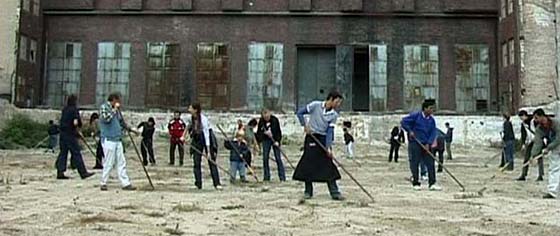
In addition to ancient Dionysian themes, Giuliana Cunéaz reflects
on the theme of memory and disorientation through a video installation
created in collaboration with some residents of Berlin, who were asked
to rake soil for an ideal natural space located in the center of the
city, as if that simple request could unearth a desire to find their
own roots. In the words of Fyodor Dostoyevsky, these are Notes from
Underground brought to light through exhaustive self-analysis.
“Raking soil was a way of digging through the incomprehensible,
unknown and enigmatic world in order to concentrate on a primary element,
a place of death and birth, in order to momentarily escape from the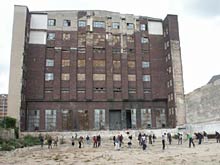 sharply drawn rhythms of society in an attempt to listen to the most
hidden parts of ourselves through the underground of the soul. I also
wanted to emphasize the relationship between identity and formative
processes, beginning with awareness that the individual is a crowd,”
the artist explains. The title, Terrains Vagues, refers to the undefined
areas that so aptly link the end of one world with the beginning of
another. In short, this is a universe of abandoned spaces and free spaces—including
mental spaces. As is often the case in Giuliana Cunéaz’s
work, border areas are explored using a mental map that allows her to
point out that which defies rationality. The “Terrains Vagues”
project also reflects on one of the great issues in contemporary art:
the vacuum, both physical and existential, set forth as an ideal in
work by artists such as Lucio Fontana and Yves Klein, who have gone
beyond the physical dimension to the psychological.
sharply drawn rhythms of society in an attempt to listen to the most
hidden parts of ourselves through the underground of the soul. I also
wanted to emphasize the relationship between identity and formative
processes, beginning with awareness that the individual is a crowd,”
the artist explains. The title, Terrains Vagues, refers to the undefined
areas that so aptly link the end of one world with the beginning of
another. In short, this is a universe of abandoned spaces and free spaces—including
mental spaces. As is often the case in Giuliana Cunéaz’s
work, border areas are explored using a mental map that allows her to
point out that which defies rationality. The “Terrains Vagues”
project also reflects on one of the great issues in contemporary art:
the vacuum, both physical and existential, set forth as an ideal in
work by artists such as Lucio Fontana and Yves Klein, who have gone
beyond the physical dimension to the psychological.
|